
Monday, December 23, 2013
2014 Resolutions

Sunday, December 15, 2013
Science Mentor Text Linky Liquids and Solids

This week I'm linking up with Collaboration Cuties' Must Read Mentor Text Linky for Science. The text I'm sharing is Infotrek's Liquids and Solids.


This is a very good non-fiction text for introducing Solids and Liquids. The content is introduced in Question/Answer expository format, which easily lends itself to building shema with a K-W-L, for example, before introducing each new question.
True to non-fiction books, each page of the text contains nice large photographs of solids and liquids to support the text.
Questions and answers are written in a way that children can easily compare and contrast solids and liquids using either a T-Chart or Venn diagram. Some examples of questions are, What do liquids look like?, What do solids look like? Can liquids change into solids? and, Can solids change into liquids?


Liquids and Solids is ideal for students to use the questions to begin many cool solids and liquids investigations using the scientific method. Very informative!
Thanks,
Lori

Wednesday, December 4, 2013
STEM Engineering Design Bridges

Every step of learning the Engineering Design Process was an exciting adventure for my second graders. They especially loved designing their own gnomes, gnome lands and finally getting to the design step of the engineering design process.
My school uses the FOSS Solids and Liquids Kit, so it was quite a challenge for my primary students to process (just as real engineers do) how to use what they knew about the properties of their solids, which included materials like cups, cardboard squares, wooden cylinders, and craft sticks, to build their bridges, complete with posts, roadways, guardrails and height. Their designs were amazing and I'm thrilled to share some of them.


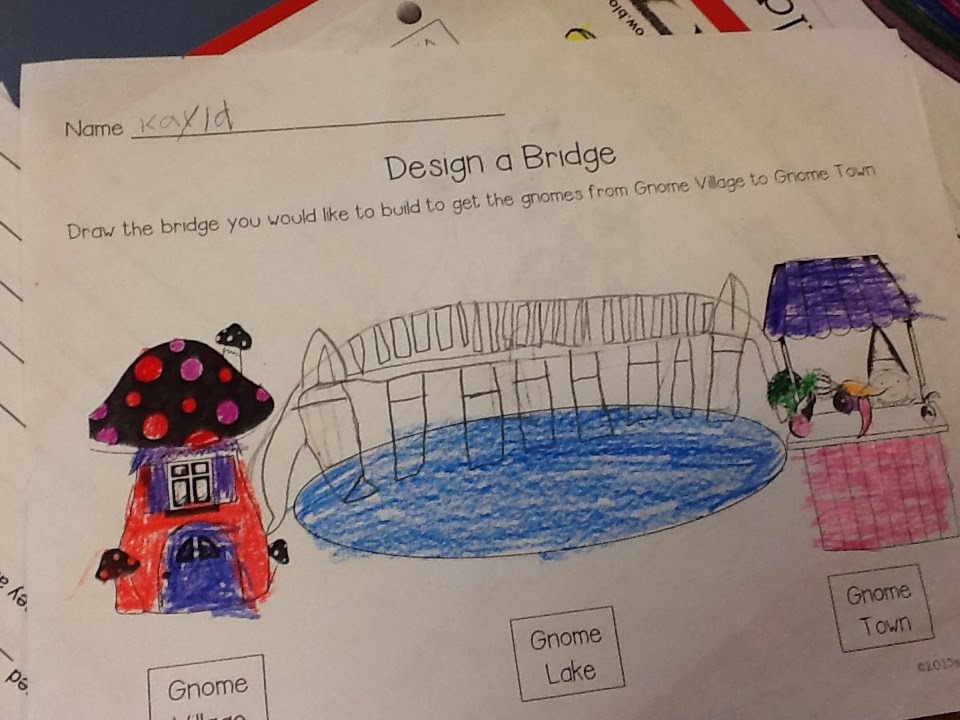


My students learned so much about the engineering design process by doing this project. Many wrote in their evaluations that they loved building with the solids, and they didn't like that it took so long from start to finish--something that is very challenging for little learners. It was a great experience for us all.
Thanks,
Lori

Friday, November 29, 2013
Cyber Monday Sale!

I have learned so much from reading the blogs of the best and top TpT Sellers. I am thankful that I have this opportunity as well to share what I absolutely love to do with my colleagues.
Wishing everyone the very best during this season of thanksgiving.
Here's a look at some of my products for sale:


Please be sure to leave any feedback you might have after purchasing products from my store. You earn TpT points towards future TpT purchases!
Thankfully,
Lori
Sunday, November 10, 2013
I Have Who Has Solids Vocab Practice

I've been teaching my students vocabulary words for solids. We will have a test soon, so I made this I Have Who Has game to use as review. All of the pictures on the cards are of the equipment that we have used so far in our investigations, or will use throughout the year. I teach first graders so the pictures are very helpful at this point of the year.
These cards would also go perfectly with the FOSS Solids and Liquids kit.
The cards have cut lines on them, so they should be very easy to cut apart neatly after laminating.
I plan to use the cards in a center. I use each of my five tables in my science room as stations, each having from three to five students at a table. This is a perfect number for this I Have Who Has game. Students at this center will pass out the cards evenly among the students at the table. The student who holds the "I WILL START, I have a solid...Who has a triangle?" card will begin the game by reading his/her card aloud and then puts it down on the table.


Thursday, November 7, 2013
So Excited! I'm Having My Very First TpT Sale!
My goal is to have a bunch of sales by Sunday night, so head on over to my store and take a look at my products. I'm sure there will be something you could use in your classroom. Thanks for your support friends!
Saturday, October 19, 2013
FOSS Solids Task Cards

After cutting and laminating multiple copies, I plan to use the task cards as a small group activity at first. After all groups have completed the cards and recorded their answers, I will project them from my Smart Board and discuss the answers as a whole group activity.
My science tables can hold up to five students, which I have divided into smaller pairs or triads which are perfect for doing our science investigations. These pairs or triads of students within the small table group will divide one deck of task cards in half. They will then complete half of the cards together with their partners on their answer sheets, then exchange their half deck with the other pair/triad at their table group. Students can then check their answers against the answer key which is provided. Since there are two groups within a group, I will provide two answer keys.


You can get your set of SolidsTask Cards and more of my products at my TpT store. Please be sure to leave your feedback.
Thanks,
Lori

Monday, September 30, 2013
Fall Writing Anchor Chart


You can pick up this product as well as other useful products in my store. Please leave your feedback and be sure to check out my freebies as well. You can earn TpT credits towards other TpT products as well.
Enjoy!
Lori
Sunday, September 15, 2013
Oak Tree Life Cycle and Craftivity

I found a great photographic life cycle at Pre-Kinders.com, where I could show students actual photos of an acorn's development into a huge oak tree from start to finish.

I love the idea on this site to use the life cycle pictures for having students create their own life cycle.


I hope you enjoy this idea. You can find this product in my TpT store. I would love to get your feedback and find out how you would use it with your kiddos.
Monday, September 2, 2013
Scientists Notebook Anchor Chart and (Editable) Welcome Bunting Freebie
 The first week of school was absolutely exhausting yet exciting. My K-2 kiddos are so adorable and excited about school. They were especially eager to visit the science room to see what they would be doing in science class this year.
 I started off the year with a SMART board discussion on the questions, What is Science? and What do Scientists Do?
This week I will extend the discussion with an anchor chart. I use a color anchor chart as a SMART Board to review with the children what they learned previously about scientists; specifically, what scientists do/are/need. As we discuss each section I fill in the chart as a whole group lesson.


Welcome Bunting Freebie
To welcome my students to the Science Room this year, I made a colorful WELCOME Bunting which I hung atop my SMART Board. I copied the pages onto construction paper and then cut out each flag of the bunting. You could also copy them onto card stock to make them more firm.

Visit my TpT Store to get your Scientist Notebook Anchor Chart and a FREEBIE of my (Editable) WELCOME Bunting and leave me your feedback about these or other products in my store.
Have a fantastic week!
**Lori**

Subscribe to:
Posts (Atom)